|
Jacksonville Area Diving
What's diving like in the Jacksonville area?
Few
divers think of Jacksonville when they think of great Florida diving.
But the diving here is often surprisingly good. We think it is one
of the better kept secrets around. The area water is rich with
nutrients.
This
does meaning that average visibilities are lower than the
average visibility in South Florida or the Florida Keys. But
it also means richer sea life in greater abundance.
In today's Florida Keys diving, a school of even 100 fish bigger
than juveniles has become unusual. Offshore Jacksonville, it is
still not uncommon to see
schools of thousands of grunts or baitfish which can totally obscure
a wreck from 30 feet away.
A newly-placed wreck
in Miami or farther south may have been down for years; yet
you can still easily read painted letters
on the hull. A wreck which has been down half that length of time
in Jacksonville often has its painted signs completely obscured
by inches of thick growth. And thick growth is food for the ecosystem.
As with any ocean location,
storms or unseasonable thermoclines can trash the temperatures
or take visibility down to zero. But typical
area
summer visibilities
range
from 40 to
100 feet with bottom temps in the low 80's at sport diving depths.
Typical winter visibilities might be more like 15 to 40 feet with
bottom
temps in the 50's.
The St. Johns River
exits into the ocean at the Mayport Jetties on the southeast
side of Jacksonville; carrying with it a dark
brown natural, tannin-stained color and its associated poor
visibility. This staining
limits
typical
visibilities
within a few miles of shore. The point where this ends varies.
Sometimes the 'viz is Ok as close in as 5 miles out. But by
9 miles out the visibilities are unaffected by that issue.
There is a great deal
of diving variety within sport diving depths. Dive spots offshore
Jax are grouped in broad roughly rectangular areas named "quandrants".
In the nearer-shore area quadrants like "9-Mile", depths typically
vary
from 68 to
85
feet on the
sand.
Shallower
basic training
depths
in the 60 foot range can be found on the upper decks and bridges
of some wrecks.
The very productive hunting
areas more like 15 to 20 miles offshore typically range from 90
to 120 or more feet in depth. Jacksonville diving extends all the
way to the
Gulf
Stream (whose track varies from 60 to 90 miles or so
offshore) at which depths range from 120+ feet to as deep as you
care to go.
Currents are not unusual
offshore. It's usually a good idea to keep your discipline in
coming back up the anchor line. Carrying a safety sausage or
similar signaling device is pretty much standard here since currents
are common and the public dive boats are usually tied in or anchored.
Thus if you
miss the anchor line and the boat, they cannot pull up to come
get you until the rest of their divers are back
on the boat; by which time you may have drifted far enough away
that a safety sausage is very helpful.
The Jacksonville area has some natural limestone offshore ledges.
Fortunately it also has a very active artificial reef building
program. The annual Greater
Jacksonville Kingfish Tournament brings
millions of dollars of spending to the area each year. (The tournament
has had to cap the number of entries at 1,000 boats each of
the last few years)!
The tournament's impact
on the local economy has helped maintain shared goals of reef
building between the city, the
local
sportfishing club, and area divers. The city and the Jacksonville
Offshore Sport Fishing Club typically arrange for the reef material
and the funding for transporting it offshore. Volunteer divers
of the Jacksonville Reef Research
Team (a volunteer group originally
founded by our dive club) perform the underwater
engineering surveys required for reef permitting by the EPA.
As a result, there are
large numbers of dive sites offshore Jacksonville. Until a few
years ago, the 615 feet long old Dry Docks reef was the largest
offshore artificial reef on the Eastern coast of the United States.
(The
Spiegel Grove and, I believe, one or two other recent placements
are now longer).
The web
site of the TISIRI organization, a group promoting offshore
reef development and
usage, has a
number of photos and videos from offshore Jacksonville and nearby
(their site includes reef areas from the St. Augustine and Flagler
areas).
If your tastes run to fresh water diving, there are large numbers
of inland spring dives within a 2 to 3 hour drive from the area.
Where I can I book a public dive
boat?
Here are the public dive boats we know of which are currently
running the Jacksonville area. We'll be glad to list more if anyone
will
bring
them to our
attention.
Legal disclaimer:
We receive no consideration of any kind for mentioning any
of these
operations and explicitly do
not warrant these businesses, their competency,
or any related opinions or information (prices, times, etc.)
in
any way. Our descriptions below are only updated occaisonally and
will not always reflect those sites' current content.
We
are merely letting you know we've heard these options exist so
you can research them for
yourself. (Our
apologies
for
having
to
put
you
through reading this disclaimer; but the scourge of some
tort lawyers forces everyone these days to defend themselves
in advance).
-
One current public dive boat option we're aware of
involves chartering a whole boat as a
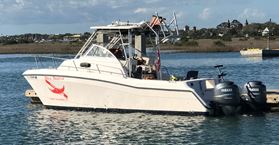 group
of up to 4 divers. The St.
Augustine dive shop "The
Dive Source" is located at 2450 Florida
SR 16, #2 near the twin off-price malls near the intersection
of I-95 and 16. They operate a pair of 26-foot Grady White power
catamarans; each running twin gas outboards. The shop provides
a Dive Master. group
of up to 4 divers. The St.
Augustine dive shop "The
Dive Source" is located at 2450 Florida
SR 16, #2 near the twin off-price malls near the intersection
of I-95 and 16. They operate a pair of 26-foot Grady White power
catamarans; each running twin gas outboards. The shop provides
a Dive Master.
For local area dives
out to 30 miles offshore, the cost is $900 for the divers for
up to 3-tank diving. Two rental tanks of air or Nitrox are included
if required and a 3rd tank is available for an additional charge.
Trips out
to 60 miles offshore cost $1,200
for the same up-to-4 divers.
All divers are required to hold either Advanced or Open Water
certs. All snorkelers are required to hold a Level 1 Free Driver
cert.
Their boats do not leave
from one specific marina. They instead trailer the boats to a
marina that works for the objectives of the divers chartering
the trip. For example many of their offshore St. Augustine trips
leave from St. Augustine's City Marina but they do offer leaving from a Jacksonville marina
if the charterers want that option. They can also work out costs for dives off of South Florida or even the
West Coast of Florida. For more information call The Dive Source at (904) 829-3483.
-
We
recently became aware of an operation called "Florida
Man Fishing Charters". They handle both fishing and
diving charters. Their web site says when their boat is configured 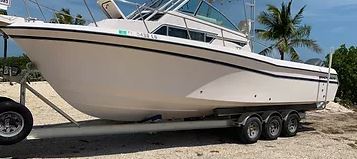 for diving, it has room for over 25 tanks and an over-sized
dive ladder. The boat is equipped with a large
cabin containing a full, private head. For more
information check their
website or call (813) 246-3474.
for diving, it has room for over 25 tanks and an over-sized
dive ladder. The boat is equipped with a large
cabin containing a full, private head. For more
information check their
website or call (813) 246-3474.
We intend to get up with this operation
next week and will add boat details and typical dive costs to this write-up.
-
Another operation is called "Due
East Chartering Service" run by Capt. Randy Marshall.
We're not aware
of him having a regular website yet but he can be reached on FaceBook.
You can call him
at (904) 866-2592. We'll attempt to contact Capt. Randy soon and will post
details
as soon as
they
are available.
-
The website of the local
dive operation "NatuticalDivers" says
the boat is equipped with a spacious climate-controlled cabin, sleeping
bunks, a galley with pizza oven, flybridge
with bean bag loungers, a bathroom, and deck seating.
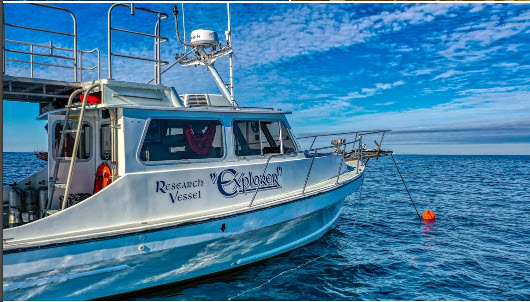 A basic 3-tank dive offshore Jax is $225 per diver. Tanks are NOT
provided in that cost. A basic 3-tank dive offshore Jax is $225 per diver. Tanks are NOT
provided in that cost.
Because of the challenging conditions offshore Jacksonville, all
divers must be Advanced Open Water Divers with NITROX
certifications and will need to bring their own dive gear and tanks.
Student divers
are not permitted on their charters
unless they are Advanced Open Water Diver students with a NITROX
certification and are accompanied by a certified dive instructor.
The boat offers a diver lift - no more climbing a ladder.
It has a 750lb capacity and offers
easier access to the deck after a dive.
Each charter includes access to the entire vessel and amenities, a marine rescue GPS unit, snacks, non-alcoholic beverages, and lunch.
For more information check their
website or call (813) 246-3474.
If anyone knows of additional
public dive boat options, please contact our WebMaster with
details so we can help those divers without a private boat
connectionl
get
in the
local
waters.
What
are the current dive conditions offshore Jacksonville?
Unfortunately the NOAA
Station 41012 sea buoy, formerly found 40 miles ENE of St.
Augustine, was a victim of US Government budget cuts and was removed.
It was an excellent resource and is badly missed. We can only hope
that it will return someday.
One current
subsitute is the National Weather Service's Coastal
Marine Forecasts by Zone - Jacksonville, FL.
Recent
visibility
and subsurface conditions can also be found on our home
page when useful dive reports are available.
For additional information,
check our Dive
Links web page.
You may also want to
check the Florida East Coast Spearfishing forum on Spearboard.com.
This is a spearfishing web site whose posters are great
about mentioning bottom temps, visibility, current
information and game sightings. The forum
usually has recent postings about dives in the Jacksonville
or nearby St.
Augustine area.
|